We recently completed a full migration of the official 247COMPASS website from our legacy WordPress environment to Hugo, a static site generator.
Refining the content structure, customizing templates, building a multilingual English site (/en/), and constructing a knowledge graph for over 300 glossary terms—every step of the process was carried out in close collaboration with Codex, an AI coding agent. The local build completed without errors, and everything appeared to go smoothly in the browser post-deployment.
However, we hit a snag while submitting the sitemaps to Google Search Console (GSC). While the English sitemap was successfully indexed, the legacy Korean sitemap continuously displayed ‘Couldn’t fetch / Read error.’
The XML files on both the local environment and the live server returned an HTTP 200 OK status with zero syntax errors. So, why couldn’t the search engine read the sitemap?
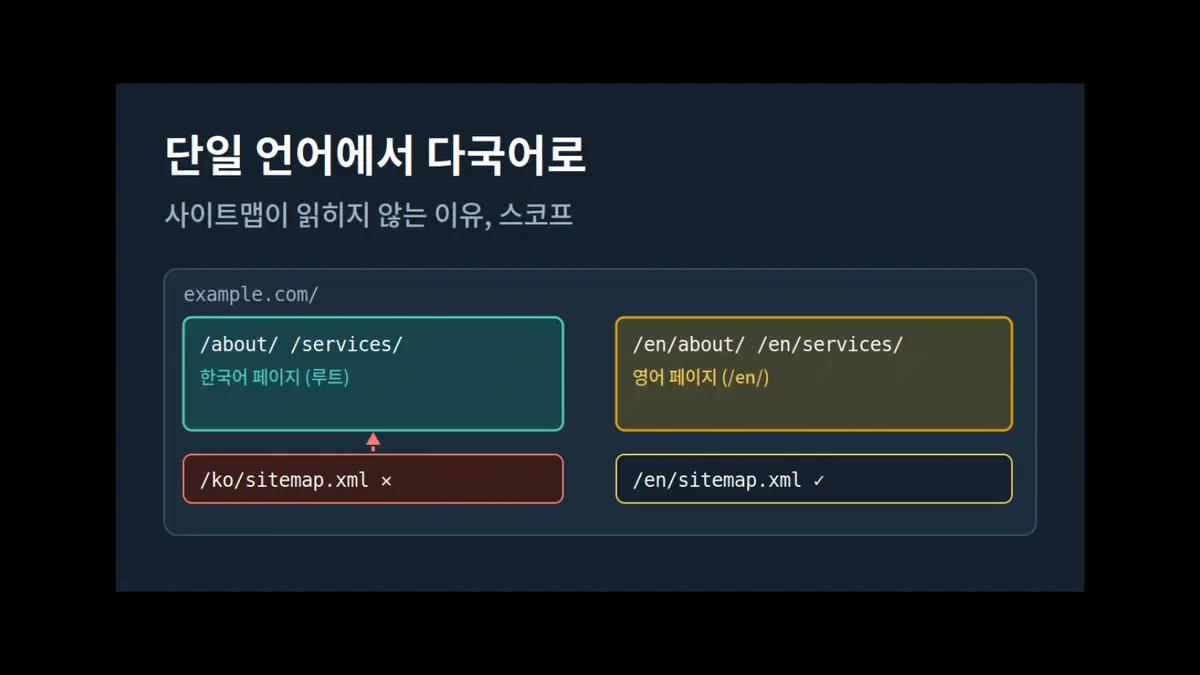
If you have extensive SEO and GEO experience, you will likely spot the issue quickly. I cross-referenced the sitemap locations with the listed URLs and confirmed that the Korean pages resided at the root, while the sitemap was located under /ko/.
When I prompted Codex with this scenario, it responded that the root cause could not be determined from the provided context alone—a remarkably smart assistant. Consequently, I provided more specific context and the desired structure, resolving the path scope clearly by moving the Korean sitemap to the root.
This experience reinforced that beyond HTTP responses and XML syntax, you must also verify sitemap locations, URL structures, and Search Console submission requirements together. For those preparing for a static site migration or multilingual expansion, we share our auditing process and applied architecture. A refined prompt that can be used for this task is also attached at the bottom of the article.
1. Common Structural Mistakes: Asymmetric URLs and Sitemap Scopes#
Companies operating a monolingual site typically aim to maintain their root domain for the primary language:
- Legacy Korean Pages:
example.com/about/,example.com/services/(Root scope) - New English Pages:
example.com/en/about/,example.com/en/services/(Subdirectory scope)
This structure itself is highly practical for preserving the backlinks and authority (SEO Equity) accumulated on the root domain and maintaining compatibility with domestic search engines like NAVER.
The issue arises when a Static Site Generator (SSG) or CMS generates and splits sitemaps automatically.
Enabling multilingual settings often prompts systems to create language-specific subfolders out of habit and fragment the sitemaps:
- English Sitemap:
example.com/en/sitemap.xml - Korean Sitemap:
example.com/ko/sitemap.xml
The English sitemap’s file location aligns with the paths of the listed URLs. Conversely, the Korean sitemap does not match the default directory scope. This is the exact point where submission methods and ownership verification conditions must be reviewed together.
2. Search Engine Rules: The ‘Sitemap Path-Scope’ Constraint#
When auditing sitemaps, you must first check the default directory scope based on the file location.
Default Path Scope of Sitemaps:
Sitemaps generally target URLs within the directory where they are placed and its subdirectories.
- English Sitemap (
/en/sitemap.xml):- Sitemap Location:
/en/ - Listed Pages:
/en/about/,/en/services/ - Verdict: The file location and listed URLs match, fulfilling the default path-scope requirement.
- Sitemap Location:
- Korean Sitemap (
/ko/sitemap.xml):- Sitemap Location:
/ko/ - Listed Pages:
/about/,/services/(Root path) - Verdict: Because the listed URLs reside outside
/ko/, they do not match the default path scope.
- Sitemap Location:
Note that Google states exceptions to this directory restriction may apply to sitemaps submitted via Search Console. Therefore, you cannot conclude that all submissions will fail based solely on this path discrepancy. Cross-site submissions, which include URLs from multiple domains in a single sitemap, also follow procedures with separate ownership verification conditions. Google Official Sitemaps Guide
This time, we relocated the Korean sitemap to the root to satisfy the default path scope without relying on submission conditions. While HTTP 200 and valid XML are important inspection items, determining the root cause of GSC errors requires reviewing detailed error messages, the last fetch time, and server logs together.
3. Multilingual Site Architecture Selection Guide#
What URL structure and sitemap strategy should you adopt when transitioning to a multilingual site? There are two primary standard models.
Try switching the structure tabs in the diagram below and clicking directly on the sitemap files. You can instantly verify whether the URLs declared by a file fall within its scope.
Model A: Root Default Language + Language Subdirectories (Ideal for retaining legacy default-language URLs)#
- Target Audience: Enterprises where maintaining domestic search rankings on the existing domain is critical, and the number of supported languages is small (e.g., Korean + English).
- Sitemap Solution:
- Promote the Korean sitemap to the root level instead of keeping it under
/ko/:example.com/sitemap-ko.xml - Declare
example.com/sitemap.xmlat the root as a superior Sitemap Index, configured to reference/sitemap-ko.xmland/en/sitemap.xmlas children. - This ensures that the scope of
sitemap-ko.xmlcovers the entire root, thereby satisfying the default path-scope requirement. Actual indexing status must be verified separately in GSC.
- Promote the Korean sitemap to the root level instead of keeping it under
Model B: Fully Symmetric Subdirectories (/ko/, /en/, /ja/) (Recommended for Global Expansion)#
- Target Audience: Enterprises simultaneously targeting multiple language markets or requiring completely segregated regional marketing dashboards.
- Characteristics:
- Place a language selection screen at the root (
example.com/) and isolate all substantive content underexample.com/ko/andexample.com/en/. - Sitemaps are also generated symmetrically as
example.com/ko/sitemap.xml, entirely preventing scope conflicts. - Drawback: Because all legacy root URLs must be 301 redirected to
/ko/, you must endure temporary traffic fluctuations while search engines re-crawl and learn the updated addresses.
- Place a language selection screen at the root (
4. Practical Checklist: 4 Essential Pre-Deployment Steps#
If you are preparing a multilingual site migration, be sure to complete these 4 checks before hitting deploy.
- Verify Bidirectional Hreflang Tags:
- Ensure that the
<head>of both Korean and English pages contain bidirectional, 1:1 mappedhreflangtags (ko,en,x-default) pointing to each other and themselves.
- Ensure that the
- Validate Sitemap File Locations and Listed URL Scopes:
- Confirm that
<loc>URLs inside the sitemap XML do not infringe upon paths higher than the directory where the sitemap file resides.
- Confirm that
- Implement 301 Redirects for Legacy URLs:
- If
/ko/sitemap.xmlor legacy URLs from a previous CMS previously crawled by Search Console still exist, apply permanent 301 redirects rather than 404 errors to prevent wasting crawl budget.
- If
- Build Automated Build Pipeline Validation Scripts:
- Integrate scripts into your CI/CD build process to automatically inspect sitemap file paths in static outputs and XML URL scopes, preventing post-deployment errors proactively.