While search engines change how they answer, are brands actually listening to customer questions?
Working in Search Optimization for a long time, you tend to see a similar pattern emerge whenever a new technology arrives.
Talk arises that a specific technology has become critical, and voices immediately grow louder insisting that it must be adopted. A few years ago, it was structured data and rich results; recently, AI search and GEO have taken that spot. The ability to quickly understand and apply new technologies is undoubtedly important. After all, my job is to observe search engine shifts and consider how those changes impact corporate marketing.
Yet, every now and then, a thought crosses my mind.
What are we actually applying these technologies for?
Not long ago, NAVER announced that it would overhaul its search result UI/UX and discontinue the display of dedicated HowTo search results. Prior to that, it also ended the search result display of FAQ structured data. Similarly, Google has been scaling back or terminating FAQ and HowTo rich results since 2023.
In other words, features that were once treated as crucial in SEO practice are gradually disappearing from search results one by one.
However, there is an interesting aspect to this.
While specific formats displaying questions and answers in search results are fading, the questions people throw at search engines are still very much alive. In fact, with the rise of AI search, people can now explain their circumstances instead of using short keywords and ask questions about what they want to know in a conversational manner.
The way search engines understand questions and provide answers is evolving rapidly.
So, what about brands?
Brands still remain accustomed to explaining how exceptional they are. They talk about product strengths, emphasize long histories and technical prowess, and dedicate massive resources to communicating why they are better than competitors.
Of course, communicating brand value is important. But how deeply do we consider why customers are searching right now, or what situations and concerns drive them?
Customers search to solve their problems, yet brands often just talk about whatever they want to say.
As the search environment shifts rapidly, I hope marketers will rethink this gap.
Why did search engines start showing questions and answers?
Though familiar now, search results did not always display such diverse information from the beginning.
Past search results primarily consisted of titles, URLs, and brief descriptions. Users had to visit multiple sites just to verify which page contained the information they needed.
To reduce this friction, search engines began displaying information contained within web pages directly in search results. This approach showcased specific data from documents, such as product prices and ratings, recipe cooking times, or movie details—features we commonly call rich results.
Structured data technologies, including Schema.org, played a vital role here. When websites explained the meaning of specific information in a predefined format, search engines leveraged it to construct richer search results.
FAQs and HowTos were also utilized amid these changes.
FAQs displayed potential user questions and answers right in the search results, while HowTos guided users through tasks step by step. For instance, if someone searched for leather bag care methods, they could preview necessary procedures before visiting the website.
This was an attractive feature for marketers as well.
Even at the same search ranking, it allowed information to be displayed across a wider area than standard text results, securing opportunities to catch search users' attention.
Over time, however, search engines began readjusting these presentation methods.
Shifts observed in Google and NAVER
In August 2023, Google announced that FAQ rich results would be largely restricted to authoritative government and healthcare websites. In September of the same year, it also terminated support for displaying HowTo rich results.
By 2025, additional structured data-driven search features were streamlined. Google explained its direction to make search results more concise by systematically phasing out features deemed to have low usage or insufficient user value.
Similar changes unfolded at NAVER.
Following the announcement in July 2026 to end the search result display of FAQ structured data, NAVER transitioned dedicated HowTo search results into standard search results on October 15.
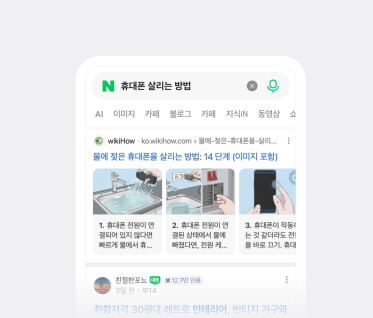
An image illustrating the dedicated format prior to the change. Source: NAVER Search Advisor Official Notice
There was another interesting detail in NAVER's recent announcement: unifying the UI of Web, Blog, Cafe, KnowledgeiN, and Video search results, and displaying supplementary information from certain structured data—such as addresses, ratings, recipes, and reviews—in a brief summary format.
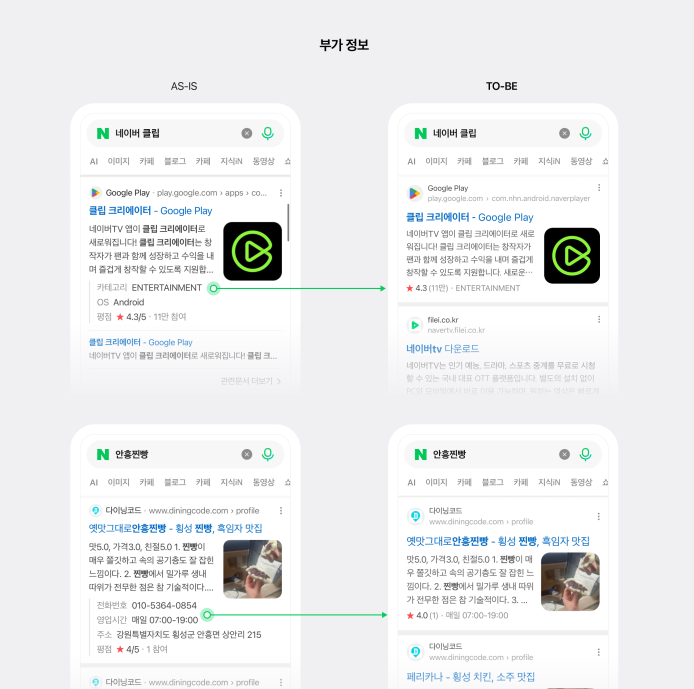
AS-IS / TO-BE comparison examples released by NAVER. Source: NAVER Search Advisor Official Notice
In short, features that once enriched search results are now being organized into concise formats.
Of course, this does not mean structured data itself has become obsolete. NAVER explained that there is no need to remove existing HowTo markup, and that this change does not impact document crawling, indexing, or organic SERP rankings.
What is changing is the way information is expressed.
Then why are search engines scaling back rich results that they provided for so long?
The officially stated reasons are to simplify search results and deliver a consistent user experience. However, with AI search advancing rapidly, I believe this shift leads to yet another question.
How will the role of search results—which used to display fixed questions and answers—transform moving forward?
The questions remain the same, but the way they are answered is changing
FAQ and HowTo rich results share a common trait: they present information pre-written by websites in formats mandated by search engines.
AI-driven search, on the other hand, operates a bit differently.
It interprets user queries, retrieves relevant data, and constructs answers tailored to the context of the question. While operational mechanisms vary across search systems, the ability to explore information more flexibly than traditional fixed result displays is fascinating.
Imagine someone searching for 'VPN recommendation'.
They might be planning an overseas trip, or perhaps they are worried about using public Wi-Fi. Someone living abroad who wants to access Korean online services could use the exact same search term.
The search term is identical, but the problems the three individuals are trying to solve differ.
In the past, users had to visit multiple pages in search results to piece together what they needed. Now, however, they can explain their situation to an AI search engine, receive an answer, and follow up with additional questions.
They can ask, 'Do I need a VPN for a trip to Japan?' and then refine their query based on the device they use and the services required.
As search engines expand how they comprehend human queries, people are gradually shifting how they interact with search engines.
I find this transformation even more fascinating than the simple advancement of search technology.
For a long time, we were accustomed to choosing words that search engines could easily digest. We condensed our curiosities into a few keywords, and if the desired results failed to appear, we typed in different terms.
Now, however, we can explain our circumstances more naturally. Even without formulating a precise query from the start, users can uncover necessary information through an ongoing dialogue.
The starting point of search is broadening from keywords to situations and context.
This does not mean we can definitively conclude that these features were terminated solely because AI search directly replaces FAQ and HowTo rich results. Google's streamlining of rich results was underway well before today's AI search experiences scaled up.
Nevertheless, in the current search landscape where both changes intersect, one point is worth pondering.
While search engines try to understand user queries in increasingly diverse ways, how deeply do brands actually understand customer questions?
Structured Data and Rich Results
- 01Page Information
Questions, answers, or procedures written by websites
- 02Markup Explaining Meaning
Expressing information types and relationships using formats like Schema.org
- 03Search Result Expression
Displaying supplementary information based on supported features and policies
AI-Driven Search Answers
- 01User Queries and Context
Queries encompassing situations, goals, and conditions
- 02Relevant Information Exploration
Interpreting questions and retrieving relevant materials
- 03Context-Tailored Answer Construction
Synthesizing info to answer and sparking follow-up questions
This is a conceptual diagram for illustrative purposes. Structured data is an information expression format, while rich results are search interface features. Detailed AI search operational mechanisms vary by service, and the two currents can be utilized together. This diagram does not attribute the termination of rich results solely to AI.
Whose story are brands telling today?
There is a scene I frequently encounter in marketing work.
Brands know their strengths inside out. They can talk endlessly about their long history, technical skills, quality, and design philosophy, while clearly explaining how they differ from competitors.
Yet, the reasons customers search for brands vary far more than one might expect.
Let us consider a customer searching for a luxury brand handbag.
They might be discovering the brand for the first time, or perhaps they have been paying attention for years and are contemplating their first purchase. Some might be comparing the dimensions or materials of a specific product. Others might already own the item and be looking for maintenance instructions.
The brand and product remain identical, but what the customers are curious about differs entirely.
Yet, the content provided by brands often looks uniform: recounting brand history and craftsmanship, emphasizing design philosophy or the traits of a new collection.
Certainly, these narratives are necessary. They showcase the intrinsic value of a brand.
However, what a customer contemplating their first purchase cares about most might be somewhat different.
They may want to know how heavy it actually is, whether a laptop fits inside, how the material ages with long-term use, or how it compares to other products in a similar price bracket.
In essence, the brand is talking about craftsmanship, while the customer is wondering if their laptop will fit inside the bag.
While this may sound like an extreme example, it is a gap frequently encountered in real-world marketing environments.
I believe this distinction matters.
The value a brand wants to communicate does not always align with the information a customer needs at that moment. This does not mean abandoning brand stories to deliver only what customers ask about.
Rather, great marketing is closer to finding the intersection point between the two.
It means connecting the brand's core value to the actual problems customers grapple with.
And making that connection possible is what I consider crucial: Context.
Brand Value
Craftsmanship
Material & Design Philosophy
Heritage & Quality
Customer Questions
How heavy is it?
Will my laptop fit?
How does it age with use?
Explaining material traits through actual weight and tactile feel,
and displaying size and storage details aligned with customer daily life.
This explanation is reconstructed based on the bag case study in the main text.
Context is the user's situation behind the keyword
When discussing SEO, the term Search Intent is frequently used.
It is a framework used to distinguish whether users are looking for information, trying to navigate to a specific website, or considering a purchase. It serves as a useful benchmark when establishing search strategies.
However, I believe that search intent alone is insufficient to fully explain the customer.
This is because even when using identical search terms, the situations and experiences customers face can vary widely.
For instance, let us think about the search term 'water purifier rental'.
It could be searched by someone preparing to move, or a newlywed couple planning a wedding. It might be someone whose existing purifier contract is ending and is exploring new products, or a parent whose household welcomed a young child, prompting them to prioritize water hygiene.
Looking at the search term alone, all these customers appear identical.
Yet once we examine their respective situations, the narrative shifts.
The person moving may be curious about installation schedules and relocation conditions. The newlyweds might compare monthly rental fees with long-term maintenance costs, while the customer considering re-rental may want to verify cancellation terms for their existing contract or new sign-up benefits.
Customers use the same search term, but they seek to solve entirely different problems.
The Context I speak of is understanding precisely these differences.
It involves examining what environment customers are currently placed in, what they have experienced, what choices lie ahead of them, and consequently why they searched at this exact moment.
Search terms are vital clues for understanding customer thought processes. Yet keywords alone cannot reveal every facet of a person's current situation.
For a long time, I have valued context over keywords in marketing.
This is because I felt that merely knowing what words customers use was not enough. I believed that only by understanding the experiences and circumstances that led them to choose those words could we truly deliver the information customers needed.
The evolution of AI search forces us to rethink this perspective.
If people can explain their situations more specifically, search systems will naturally leverage that context to construct answers.
Should brands, therefore, evolve their approach to understanding customers on a deeper level as well?
Search Term “Water Purifier Rental”
- Someone Preparing to Move
- Information Needed NowInstallation schedules and
relocation conditions - Someone Planning a Wedding
- Information Needed NowMonthly rental fees and
long-term maintenance costs - Someone Whose Contract Ended
- Information Needed NowExisting contract cancellation terms and
new sign-up benefits
This is an example of situations appearing in the main text. Individual circumstances cannot be definitively determined by search terms alone.
Are we missing customer questions while rushing to adopt new technologies?
Observing NAVER's recent changes also prompted me to rethink the role of structured data.
Structured data is a technology that explains the meaning of information contained in web pages to search systems. It helps machines clearly distinguish content that humans grasp intuitively, such as product names, prices, reviews, and author details.
It is a technology used for a long time, and it still plays a critical role.
However, whenever new SEO or GEO strategies are discussed, structured data itself is often introduced as if it were the core competitive edge driving search performance.
How many schemas were applied and how many structured data items were added are sometimes framed as pivotal project achievements.
Certainly, fixing a site lacking technical implementation is necessary. But structured data alone does not automatically make content better.
Let us take product detail pages as an example.
Product names, prices, brands, and stock statuses are accurately expressed using structured data. Technical preparations have been completed so search systems can understand product information.
Yet, are the details customers actually wonder about before purchasing sufficiently explained?
What if information regarding the actual dimensions, potential inconveniences during use, or suitable use cases is lacking?
Can structured data answer those questions on its own?
I believe it cannot.
While structured data helps explain the meaning of pre-existing information, it cannot manufacture the information customers actually need.
We must first understand customer questions and create content that answers them. Only then is structuring that information so search systems can read it accurately the natural sequence to follow.
Google has likewise emphasized that structured data must match actual page content. It explains that adding information to markup that is not shown to users, or providing details different from actual content, is inappropriate.
Considering these points, the role of structured data is relatively clear.
It is not a technology that manufactures content value in our place, but rather a tool to convey the information within content more accurately.
Whenever a new technology emerges, I hope we ask ourselves this question.
Are we applying this technology to better solve customer problems, or has adopting the technology itself become the sole objective?
What should we leave in the space where FAQs used to be?
Just because FAQ and HowTo rich results have ended does not mean we no longer need to create such content.
In fact, I believe content addressing questions and answers will remain vital moving forward. As long as people do not stop asking questions, information answering those queries will continue to be necessary.
However, the reasons for creating such content will likely need to shift slightly.
In the past, some sites added FAQs simply to expose more information in search results. This approach involved drafting questions and answers and applying structured data to secure rich results.
If dedicated rich results disappear, content created solely for that purpose warrants re-evaluation.
Are those FAQs genuinely providing information that customers need?
The same applies to HowTos.
Even if step-by-step guidance is no longer provided in search results, users still install products, utilize services, and seek troubleshooting methods when issues arise.
The dedicated search results have vanished, but the problems customers are trying to solve remain unchanged.
Can we view these questions from a slightly different perspective?
Frequently asked customer questions are not merely a list of search keywords; they are clues showing where customers encounter friction.
Examining inquiries repeatedly submitted to customer service uncovers areas the brand failed to explain adequately. Complaints repeatedly surfacing in product reviews or communities may also reveal discrepancies between the product strengths envisioned by the brand and real-world user experiences.
Gathering this information transforms our perspective on content as well.
Before obsessing over which pages to add for specific keywords, we examine the bottlenecks customers face throughout their journey.
From the moment they first understand a product, to comparing various alternatives, making a purchase decision, and actually using it.
Organizing and connecting the information needed across that journey will naturally shape the site's information architecture.
I consider this to be an Information Architecture born from the process of understanding customers.
While it involves building categories and internal links for search engines, it is fundamentally about paving a path for customers to solve their own problems first.
The effort to understand customers before search engines do
SEO and GEO certainly demand technical expertise.
We must enable search engines to discover content, convey information meanings clearly, and refine sites in tune with shifting search environments.
I view these tasks as vital and ponder them continually.
Yet, from a marketing perspective, should not the starting point of this entire process ultimately be the customer?
Every time a new search technology emerges, we ponder what needs to change. When algorithms shift, we analyze the impact; when new features launch, we seek optimization methods. When structured data policies change, we review markup; as AI search expands, we discuss GEO strategies.
All of these steps are necessary.
Yet occasionally, it is worth considering why search engines are evolving this way.
Search engines have long evolved to help people find desired information more easily. Of course, commercial objectives and technical constraints of platforms also play a part. We cannot assume every change is a decision made solely for the user.
Nonetheless, how effectively they provide desired answers remains a critical competitive edge for search services.
While search engines constantly evolve to comprehend user queries, are marketers spending more time crafting content that search engines will favor?
Contemplating which keywords to use, what structured data to add, or how to appear more frequently in AI search results.
Certainly, these considerations matter. However, I feel we need time to think about what questions we should be asking the customer beforehand.
Why are customers searching right now?
What experience led that person to the search bar?
What problem do they genuinely wish to solve?
Without answering these questions thoroughly, no amount of created content or adopted technology will narrow the distance between us and our customers.
The questions have not disappeared
When NAVER announced the termination of dedicated HowTo search results, it initially appeared to be a technical shift. It involved modifying how structured data is utilized and transitioning some existing rich results into standard search results.
However, observing Google's shifts over recent years and the rise of AI search together sparked a slightly different perspective.
While search engines continually alter how they answer questions, the reasons people search remain largely consistent.
It is because they have curiosities, problems to solve, and occasionally vital choices ahead of them.
The questions have not disappeared. Instead, people have started explaining their situations more concretely and sharing concerns with search engines that they could not previously articulate. As search methods transform, the clues available to understand customers have diversified correspondingly.
This is an exciting shift for marketers.
If we previously observed what keywords customers used, we can now delve deeper into why they asked those questions in the first place. Understanding their situations and concerns empowers brands to communicate value in entirely different ways.
I believe this represents one of the essential mindsets marketers must adopt in the era of AI search.
Naturally, learning and applying new technologies must continue. But let us not forget whom those technologies are ultimately meant to serve.
Brands want to deliver their stories, whereas customers want to solve their problems.
What role should marketers play amidst this dynamic?
I believe we must be the ones who find the intersection where both stories meet.
It is about interpreting brand value to fit customer situations and delivering information customers need using the brand's voice. Search engines and AI can become powerful tools along that journey.
However, the task of understanding customer pain points can never be outsourced to technology.
Search engines will undoubtedly keep evolving. Optimization methods deemed critical today may look entirely different a few years down the road.
With every such shift, we will grapple with novel technologies and methods.
Yet amidst all these changes, there is one question I hope we never lose sight of.
Are we striving harder to communicate what the brand wants to say, or are we actively discovering the stories customers truly need?
I believe future SEO and GEO must ultimately originate from this exact question.
Because understanding the person behind the search is just as vital as understanding the search engine itself.
And the effort to understand their behavior, background, and concerns—
that is the starting point of Context-driven marketing as I envision it.